Introduction
For any WooCommerce store owner in Australia, shipping costs can quickly erode profit margins. Australia Post is often the go-to carrier, but understanding its pricing structure and finding ways to reduce those costs requires a strategic approach. It's not just about the weight of your parcel; factors like dimensions, packaging, and even the service you select play a significant role.
This comprehensive guide will equip you with practical, actionable strategies to lower your Australia Post shipping expenses. By optimising how you package, understanding key pricing factors like volumetric weight, and making smarter service choices, you can make a real difference to your bottom line.
Understanding Australia Post's Pricing Structure
Before you can reduce your Australia Post shipping costs, you need to understand what drives them. Australia Post's pricing is dynamic and depends on several key factors. Familiarising yourself with these elements is the first step towards smarter shipping.
Key Factors Influencing Your Shipping Costs:
- Actual Weight: This is the physical weight of your package, including the product and all packaging materials. Australia Post charges by weight increments, so even a few grams over a threshold can bump up the price.
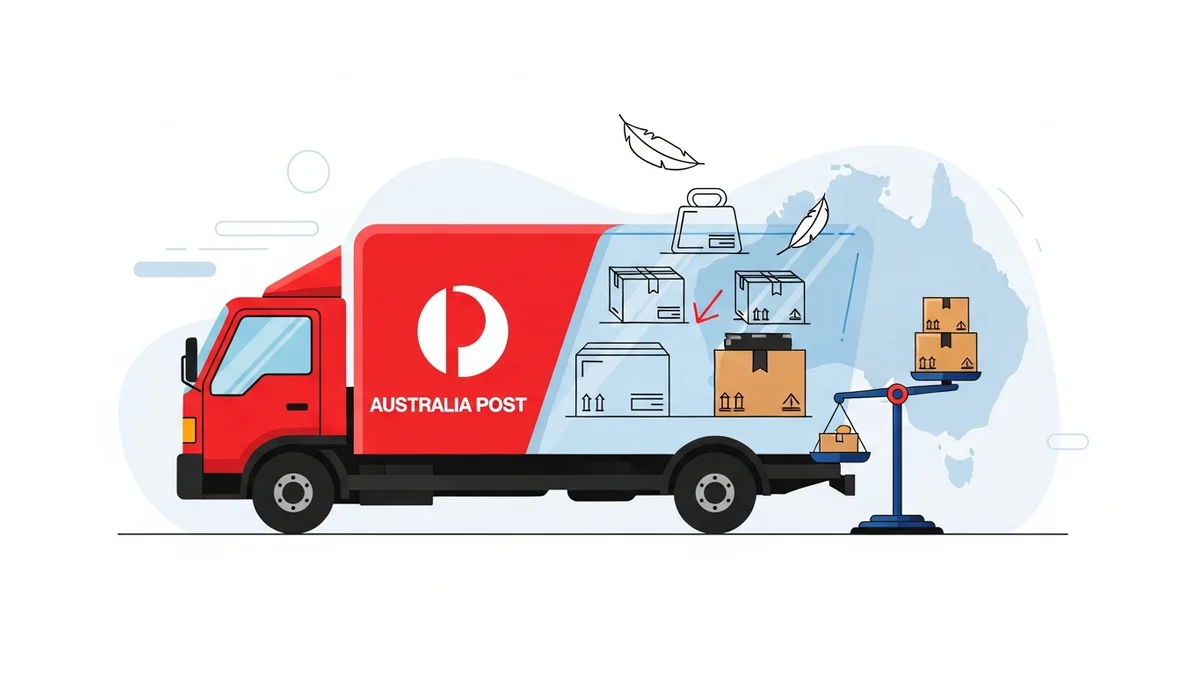
- Volumetric Weight (Cubic Weight): This is perhaps the most misunderstood and impactful factor. It's a calculation based on the dimensions (length, width, height) of your parcel, representing the space it occupies in a vehicle. Carriers charge whichever is greater: actual weight or volumetric weight. We’ll dive deeper into this soon.
- Service Type: Australia Post offers various services, such as Parcel Post, Express Post, and different options for international shipping. Each comes with different speeds and price points.
- Destination Zone: Shipping costs vary depending on how far your parcel needs to travel. Sending a package across town is typically cheaper than sending it interstate or to a regional area.
- Additional Services: Opting for extras like Signature on Delivery, Extra Cover (insurance), or specific delivery instructions can add to the base cost.
The interplay of these factors determines the final cost you pay. Often, store owners focus solely on actual weight, overlooking the significant impact of volumetric weight and the potential savings from smart service selection.
Strategy 1: Optimising Your Packaging Choices
Your packaging isn't just about protecting your product; it's a critical component of your shipping cost. Smart packaging choices can lead to substantial savings on every single parcel you send with Australia Post.
Choose the Right Size and Type of Packaging
Every centimetre of space and every gram of weight in your packaging directly impacts your shipping cost. The goal is to find the smallest, lightest, yet most protective packaging for your products.
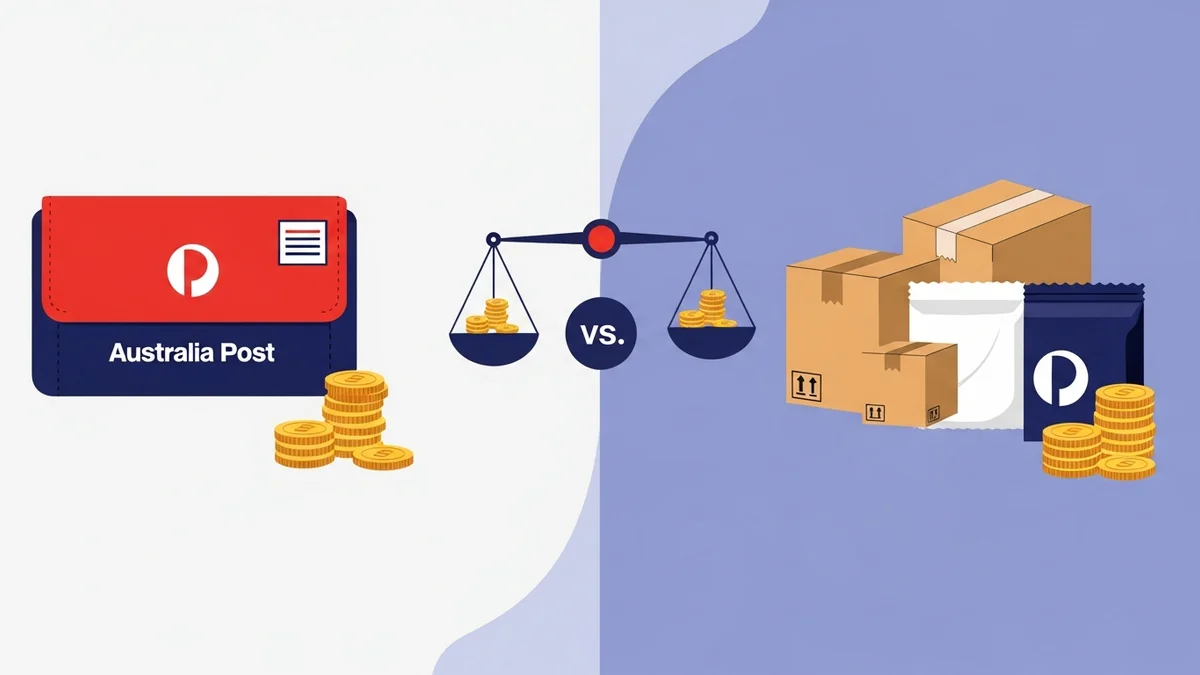
- Small Satchels vs. Mailing Boxes: For many smaller, non-fragile items like clothing, books, or small accessories, a sturdy mailing satchel is often more cost-effective than a box. Satchels conform to the item's shape, reducing void space and often resulting in a lower volumetric weight.
- Right-Sized Boxes: If you must use a box, ensure it's the correct size. Avoid using a large box for a small item. Having a range of box sizes available allows you to pick the best fit for each order, minimising empty space. Custom-sized boxes, while an upfront investment, can pay dividends for regularly shipped items.
- Padded Mailers: For delicate but flat items like jewellery or small electronics, padded mailers offer protection without the bulk of a box. They are lightweight and help keep dimensions compact.
Minimise Void Space
Empty space inside your package is essentially shipping air, and Australia Post will charge you for that air if it results in a higher volumetric weight. Reducing void space is crucial for cost savings.
- Efficient Product Arrangement: Pack items snugly. If you're shipping multiple items, try to arrange them to take up the least amount of space. For example, nest items within each other if possible.
- Use Appropriate Void Fill: Instead of bulky packing peanuts or excessive bubble wrap, consider more compact void fill options. Crinkled paper, air pillows, or even custom-cut foam inserts can protect items effectively while taking up less space. Avoid overfilling, which can make a package bulge and increase its dimensions.
- Flat-Pack When Possible: If your product can be disassembled or folded for shipping (e.g., clothing, flat-pack furniture components), this can drastically reduce the package dimensions and, consequently, the volumetric weight.
Opt for Lightweight Materials
The actual weight of your packaging materials adds to the total weight of your parcel. Even small differences can add up over many shipments.
- Lightweight Cardboard: Choose cardboard boxes with appropriate strength but not excessive thickness. For heavier items, you might need double-wall cardboard, but for lighter products, a single-wall box is often sufficient.
- Biodegradable and Eco-Friendly Options: Many modern eco-friendly packaging materials are also lightweight. Consider honeycomb paper, mushroom packaging, or recycled content boxes. These can often be lighter than traditional materials while also appealing to environmentally conscious customers.
- Tape and Labels: While seemingly minor, using lightweight packing tape and printing shipping labels directly onto adhesive sheets rather than using heavy paper and excessive tape can marginally reduce weight.
Source Packaging Smartly
Where and how you buy your packaging materials can also impact your overall costs.
- Buy in Bulk: Purchasing boxes, satchels, and void fill in larger quantities often comes with significant bulk discounts from packaging suppliers. Calculate your average usage and order accordingly to minimise per-unit costs.
- Compare Suppliers: Don't stick to the first supplier you find. Shop around and compare prices from different packaging wholesalers. Look for suppliers that offer good quality materials at competitive prices, especially if you can commit to larger orders.
- Australia Post's Own Packaging: Australia Post offers its own range of prepaid satchels and boxes. These can be convenient, but always compare their cost and size to generic options, especially if you have a Business Account where you might get better rates on standard services.
Strategy 2: Mastering Volumetric Weight
Volumetric weight, also known as cubic weight, is one of the most critical factors in Australia Post's pricing, yet it's frequently overlooked by online store owners. Understanding and optimising for it can lead to significant cost reductions.
What is Volumetric Weight?
Australia Post, like most carriers, uses volumetric weight to ensure they are fairly compensated for the space a package takes up on their transport vehicles, not just its physical weight. If a large, light package occupies a lot of space, it prevents other packages from being loaded.
The formula for calculating volumetric weight for domestic parcels with Australia Post is generally:
Length (m) x Width (m) x Height (m) x 250
This will give you the volumetric weight in kilograms. Australia Post will then charge you based on the greater of either the actual weight or the volumetric weight. So, if your package weighs 2kg but has a volumetric weight of 5kg, you'll be charged for 5kg.
For example, a box measuring 0.4m x 0.3m x 0.2m (40cm x 30cm x 20cm):
- Volumetric Weight = 0.4 x 0.3 x 0.2 x 250 = 6 kg
If this box contains a feather pillow weighing only 0.5kg, you'll still be charged for 6kg because its volumetric weight is much higher than its actual weight.
Calculating and Comparing
You should always calculate both the actual weight and the volumetric weight for your parcels, especially for items that are bulky but light. Use a reliable scale and measuring tape to get precise figures.
- Invest in Tools: A digital scale for accurate weight measurement and a sturdy measuring tape or ruler for dimensions are essential tools for any serious online seller.
- Practice Calculations: Regularly calculate volumetric weight for your common package sizes. This helps you quickly identify products that are at risk of being charged by volume.
- WooCommerce Integration: Many WooCommerce shipping plugins can help you automatically calculate volumetric weight based on product dimensions entered in your store, helping you present accurate shipping costs to customers and make informed packaging decisions.
Strategies to Reduce Volumetric Weight
Since you are charged for the greater of the two weights, your goal is to make the volumetric weight as close to the actual weight as possible, especially for lighter, bulkier items.
- Compact Packaging: As discussed in Strategy 1, using the smallest possible packaging for your product is the most effective way to reduce volumetric weight. Every centimetre saved on length, width, or height makes a difference.
- Consider Product Redesign/Repackaging: If you regularly ship a product that consistently gets charged by volumetric weight, consider if the product itself or its internal retail packaging can be made more compact. Can it be folded, disassembled, or nested?
- Remove Unnecessary Materials: Sometimes products come from suppliers in overly large boxes or with excessive internal packaging. If safe to do so, repackage items into smaller, more efficient containers before shipping to your customer.
- Vacuum Sealing: For soft goods like clothing, blankets, or pillows, vacuum sealing can drastically reduce their volume, potentially moving them from a high volumetric weight category to one based on actual weight.
Strategy 3: Smart Service Selection and Discounts
Australia Post offers a range of services, and choosing the right one for each situation, along with leveraging available discounts, can significantly impact your overall shipping expenditure.
Choosing the Right Service for Your Needs
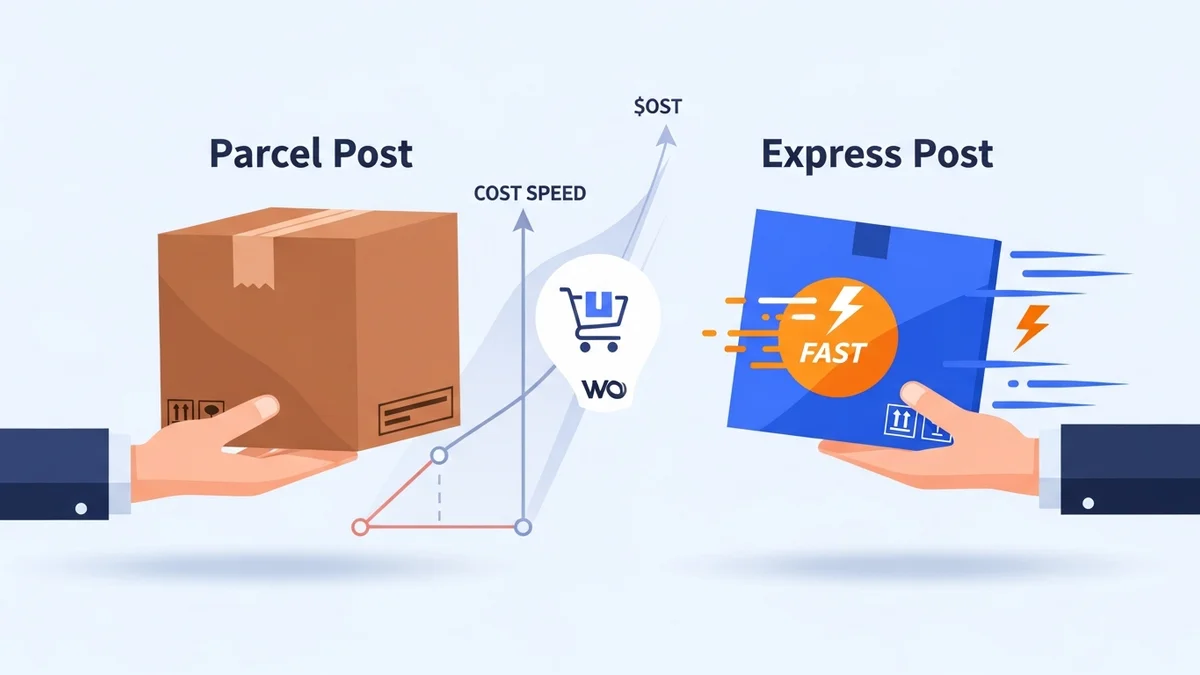
Australia Post's main domestic parcel services are Parcel Post and Express Post. Understanding when to use each is key to managing costs.
- Parcel Post: This is Australia Post's standard delivery service. It's generally more affordable and suitable for non-urgent deliveries. For most e-commerce businesses, Parcel Post will be your primary shipping option due to its cost-effectiveness.
- Express Post: Offers faster delivery times, often next-business-day delivery within the Express Post network. It's more expensive than Parcel Post and should be reserved for customers who explicitly pay for expedited shipping or for situations where speed is critical. Don't offer Express Post as a default free shipping option unless your margins can comfortably absorb the higher cost.
- International Shipping: For international orders, Australia Post offers various services like Standard, Express, and Economy Air. The choice depends on the urgency and cost preference of your international customers. Always ensure you understand customs declaration requirements and additional fees.
Leveraging an Australia Post Business Account
This is arguably one of the most impactful ways to reduce your Australia Post shipping costs if you ship regularly. A Business Account is free to set up and offers several advantages:
- Volume-Based Discounts: As your shipping volume increases, you become eligible for better rates and discounts on Parcel Post, Express Post, and international services. The more you send, the more you save per parcel.
- Access to eParcel: The eParcel system (now integrated into MyPost Business) provides a streamlined way to manage your shipping, print labels, track parcels, and access your discounted rates. It automates much of the process, reducing manual errors and saving time.
- Consolidated Invoicing: Simplifies accounting by consolidating all your shipping charges into a single monthly invoice.
- Dedicated Support: Access to business support channels can be invaluable for troubleshooting and optimising your shipping strategy.
Even if you're a relatively small sender, setting up a Business Account is highly recommended. You'll often get better rates than standard retail postage, and the discounts only grow as your business scales.
Understanding Zone-Based Pricing
Australia Post uses a zone-based pricing system. This means the cost to send a parcel to a customer in the same city or state (Zone 1-3) will be less than sending it across the country (Zone 4-8).
- Shipping Origin: If possible, consider strategically locating your warehouse or fulfilment centre closer to your largest customer base to minimise long-distance shipping costs.
- WooCommerce Shipping Zones: Set up your WooCommerce shipping zones to accurately reflect Australia Post's pricing. This allows you to charge customers more accurately based on their location, rather than undercharging for distant deliveries or overcharging for local ones.
Flat Rate vs. Calculated Shipping in WooCommerce
How you present shipping costs to your customers in WooCommerce can also impact your profitability.
- Flat Rate Shipping: Simple to set up, but risky if not carefully managed. If you offer a flat rate (e.g., $10 per order), ensure it covers your average shipping cost across various order sizes and destinations. For smaller, lighter items, a low flat rate might work. For diverse product ranges, you risk losing money on larger, heavier, or more distant orders.
- Calculated Shipping (Live Rates): Using a WooCommerce plugin that integrates directly with Australia Post's API (e.g., via your Business Account) allows your store to display real-time shipping rates at checkout. This ensures customers pay the exact cost based on their order's weight, dimensions, destination, and your negotiated Australia Post rates. This eliminates guesswork and protects your margins.
Consolidation of Orders
If a customer places multiple orders within a short timeframe, or if you offer bundles, consider consolidating them into a single shipment. This saves you money by paying for one parcel instead of multiple, especially if the combined package still falls within a favourable weight or volumetric bracket.
Strategy 4: Streamlining Your Shipping Operations
Efficient shipping operations not only save time but also prevent costly errors that can inadvertently inflate your Australia Post bills.
Accurate Weighing and Measuring
This cannot be stressed enough. Inaccurate measurements are a common reason for unexpected charges or discrepancies on your Australia Post invoices.
- Use Calibrated Equipment: Invest in a reliable digital scale and a precise measuring tape. Regularly check their accuracy.
- Standardise Your Process: Train staff on consistent weighing and measuring procedures. Always measure the packaged item, not just the product itself.
- Record Keeping: Keep records of actual and volumetric weights for common products or package configurations. This helps with consistency and troubleshooting.
If Australia Post measures your parcel as larger or heavier than what you declared, you could face additional charges or surcharges, which eat directly into your profits.
Automate Your Shipping Process
Manual data entry is prone to errors, which can lead to incorrect shipping labels, missed discounts, or even parcels being returned. Automation can significantly improve efficiency and accuracy.
- WooCommerce Shipping Plugins: Utilise a robust WooCommerce shipping plugin that integrates with Australia Post. These plugins can:
- Calculate real-time shipping rates at checkout based on your products' dimensions, weights, and the customer's location.
- Generate shipping labels instantly using your Australia Post Business Account rates.
- Automatically update order statuses and provide tracking information to customers.
- Help you compare different service options and their costs.
- Batch Label Printing: For high-volume sellers, the ability to print multiple shipping labels in a batch saves immense time and reduces the likelihood of individual errors.
Regularly Review and Audit Your Invoices
Don't just pay your Australia Post invoices without reviewing them. Errors can happen. Regularly audit your bills to ensure you are being charged correctly according to your agreed rates, declared weights, and dimensions.
- Check for Surcharges: Understand what various surcharges mean (e.g., for incorrect dimensions, remote area delivery, return to sender) and identify patterns that might indicate an issue with your packaging or data entry.
- Compare to Estimates: If you use a shipping calculator, compare the actual charges on your invoice to your internal estimates. Significant discrepancies warrant investigation.
Negotiating Rates (For High Volume Shippers)
If your WooCommerce store processes a very high volume of orders through Australia Post, you may be in a position to negotiate even better rates than those automatically provided by a standard Business Account.
- Understand Your Volume: Be prepared to demonstrate your monthly or annual shipping volume.
- Highlight Growth Potential: If your business is growing rapidly, emphasise this during negotiations.
- Be Prepared to Commit: Negotiated rates often come with volume commitments. Ensure you can meet them.
This level of negotiation is typically for businesses shipping hundreds or thousands of parcels per month, but it's a powerful tool once you reach that scale.
Related Articles
Continue your learning with these related resources:
- The Complete Guide to Managing Australia Post Shipping for Your WooCommerce Store (Comprehensive Guide)
- How Volumetric Weight Affects Your Australia Post Costs for WooCommerce Shipments
- Return to Sender vs. Abandon: Optimizing Australia Post Undeliverable Options for WooCommerce
- How to Reduce Packaging Weight to Lower Your Australia Post Costs for WooCommerce Orders
- Navigating Australia Post Dangerous Goods Rules for WooCommerce Stores
- How to Communicate Australia Post Delivery Delays to Your WooCommerce Customers
Conclusion
Reducing your Australia Post shipping costs isn't a one-time fix; it's an ongoing process of optimisation and smart decision-making. By diligently applying the strategies outlined in this guide – from meticulous packaging choices and mastering volumetric weight to selecting the right services and streamlining your operations – you can significantly impact your WooCommerce store's profitability.
Start by auditing your current shipping practices and identifying areas for improvement. Even small changes, like switching to a slightly smaller box or setting up a Business Account, can lead to substantial savings over hundreds or thousands of parcels. Take control of your shipping expenses and watch your margins grow.