Introduction
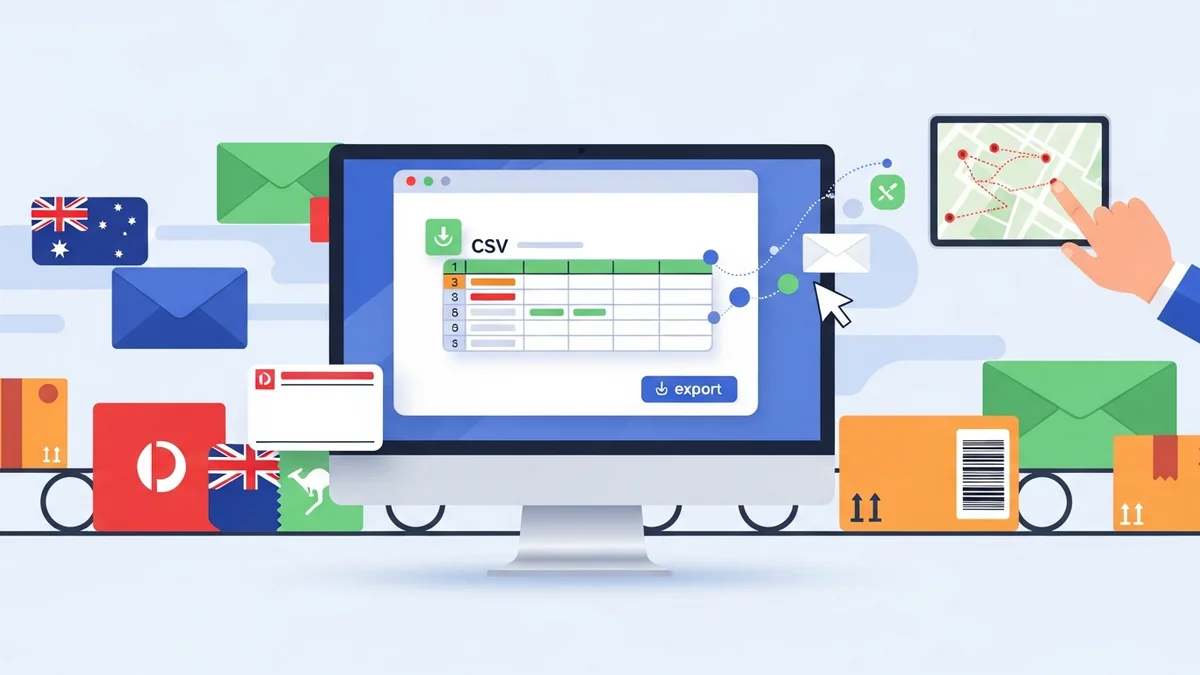
For WooCommerce store owners in Australia, managing shipping efficiently is key to customer satisfaction and business growth. Australia Post's Business Portal allows you to upload order details in a CSV (Comma Separated Values) format, enabling bulk shipping label generation. This method dramatically speeds up your dispatch process, saving valuable time.
However, despite its benefits, many store owners encounter frustrating errors during the CSV upload. These issues often stem from incorrect data formatting, missing information, or structural problems within the CSV file. This guide will walk you through the 7 most common Australia Post CSV upload errors and provide clear, actionable solutions to fix them, helping you get your parcels out the door faster.
Why Use CSV Uploads for Australia Post?
The ability to upload your order details in bulk to Australia Post offers significant advantages. Instead of manually entering each customer's address and parcel details one by one, a CSV upload lets you process dozens or even hundreds of orders in minutes. This not only saves immense time but also reduces the likelihood of manual data entry errors, which can lead to misdirected parcels or customer complaints.
Tools like the WooCommerce Australia Post CSV Export Pro plugin are specifically designed to generate these files correctly, pulling information directly from your WooCommerce orders and formatting it to Australia Post's exact specifications. This proactive approach helps prevent many common errors before they even occur.
7 Common Australia Post CSV Upload Errors and How to Fix Them
1. Error: "Missing or Incorrect Required Fields" (e.g., Postcode, State, Suburb)
Problem: This is perhaps the most common error. Australia Post requires specific information for every shipment, and if any critical field is missing or contains invalid data, your upload will fail. Error messages often point to specific missing fields like "Postcode is required" or "State is invalid."
Cause:
- Customer did not provide complete shipping details during checkout.
- The data was entered incorrectly (e.g., typo in postcode, wrong state abbreviation).
- Your WooCommerce store's checkout fields are not properly validated, allowing incomplete addresses.
- The export process from your WooCommerce store failed to include certain data fields.
Solution:
- Review Order Details: Go back to the specific WooCommerce order(s) causing the error. Check the shipping address for completeness and accuracy. If an address is genuinely incomplete, you may need to contact the customer.
- Standardize Data: Ensure state abbreviations (e.g., NSW, VIC, QLD) are consistent and correct. Postcodes must be 4 digits and valid for Australia.
- Update WooCommerce Checkout: Consider making critical address fields mandatory in your WooCommerce settings to prevent future incomplete orders.
- Use a Reliable Export Tool: A plugin like WooCommerce Australia Post CSV Export Pro pulls data directly from your WooCommerce orders and attempts to format it correctly. It also highlights orders with missing information before export, allowing you to rectify them.
2. Error: "Invalid Data Format" (e.g., Non-Numeric Postcode, Wrong State Abbreviation)
Problem: Even if a field isn't missing, its content might not conform to Australia Post's expected format. This can manifest as an error like "Postcode must be numeric" or "State value is not recognised."
Cause:
- Accidental entry of letters or symbols into numeric fields (e.g., '2000a' instead of '2000').
- Using full state names instead of two- or three-letter abbreviations (e.g., 'New South Wales' instead of 'NSW').
- Extra spaces before or after data entries.
Solution:
- Manual Correction in CSV: Open the exported CSV file in a spreadsheet program (like Google Sheets or Excel). Locate the problematic cells and correct their format. For instance, ensure postcodes are purely numerical.
- Trim Spaces: Use your spreadsheet program's "Trim" function to remove leading or trailing spaces from all relevant columns, especially address fields.
- Standardize State Codes: Ensure all Australian states use their official two or three-letter codes (NSW, VIC, QLD, SA, WA, TAS, NT, ACT).
- Leverage Plugin Automation: The WooCommerce Australia Post CSV Export Pro plugin aims to standardize these formats during export, drawing from WooCommerce's built-in address validation where possible, and converting full state names to abbreviations.
3. Error: "Incorrect CSV Structure" (Wrong Headers, Missing Columns)
Problem: Australia Post expects a very specific set of column headers and order in its CSV file. If your file has incorrect header names, missing essential columns, or extra unexpected columns, the upload will fail with errors like "Invalid header row" or "Column X not found."
Cause:
- Manually created or edited CSV files where column names were mistyped.
- Using a generic CSV export tool that doesn't adhere to Australia Post's specific template.
- An outdated export template being used.
Solution:
- Obtain Official Template: Download the latest sample CSV template from the Australia Post Business Portal to understand the exact column names and their order.
- Compare and Correct: Open your problematic CSV and the official template side-by-side. Correct any mismatched header names or add missing columns. Even if a column is empty for all orders, it must still be present in the header row.
- Use a Dedicated Plugin: This is where the WooCommerce Australia Post CSV Export Pro plugin shines. It is built specifically to generate CSV files that perfectly match Australia Post's required format, including all necessary headers and columns, preventing these structural errors entirely.
4. Error: "Special Characters or Encoding Issues"
Problem: Sometimes, an upload fails without a clear data error, or characters appear as gibberish (e.g., '?' or squares). This often points to issues with special characters (like accents, umlauts, or non-English characters) or incorrect file encoding.
Cause:
- Customer names or addresses containing characters not supported by the default encoding (usually UTF-8) expected by Australia Post.
- Saving the CSV file in an incorrect encoding (e.g., ANSI instead of UTF-8).
Solution:
- Check for Special Characters: Manually review the problematic rows in your CSV for any unusual characters. These might be in names, street addresses, or company names.
- Simplify or Replace: If possible, replace problematic special characters with their standard English equivalents (e.g., 'é' to 'e').
- Ensure UTF-8 Encoding: When saving your CSV file, ensure it's saved with "UTF-8" encoding. Most spreadsheet programs offer this option in the 'Save As' dialogue.
- Plugin Handling: Quality export plugins like WooCommerce Australia Post CSV Export Pro are designed to handle various character sets and ensure the output CSV is correctly encoded (typically UTF-8), minimising these issues.
5. Error: "Missing or Zero Parcel Weight"
Problem: Shipping carriers heavily rely on parcel weight to calculate costs and determine appropriate services. If your CSV has missing weight values or consistently shows '0' for weight, Australia Post will likely reject the upload or flag the orders for manual review.
Cause:
- Product weights are not set in your WooCommerce product data.
- Your export process doesn't correctly aggregate product weights for the order.
- Manual oversight when preparing the CSV.
Solution:
- Update Product Weights in WooCommerce: This is foundational. Go into each of your WooCommerce products and ensure accurate weight values are entered. Even if you use flat-rate shipping, accurate product weights are crucial for carrier integration.
- Set Default Weights: If some products genuinely have no weight (e.g., digital products mixed with physical), ensure your export tool has a sensible default weight (e.g., 0.5kg) to avoid '0' values for physical shipments.
- Utilize Plugin's Auto-Calculation: The WooCommerce Australia Post CSV Export Pro plugin automatically calculates the total parcel weight for each order by summing the weights of all individual products within that order. This virtually eliminates missing or zero-weight errors, and provides a default weight if product weights are missing.
6. Error: "Issues with International Order Data (Missing Customs Information)"
Problem: For international shipments, Australia Post and customs authorities require additional information beyond just the recipient's address. Errors here often manifest as "Customs declaration missing" or "Contents description required."
Cause:
- The CSV file is not configured to include customs declaration fields (e.g., contents description, value, country of origin).
- Product information (like HS codes, country of origin) is missing in WooCommerce.
- Attempting to use a domestic-only CSV template for international orders.
Solution:
- Use International-Compatible Template: Ensure your CSV template includes all necessary international customs declaration fields.
- Provide Detailed Product Descriptions: For each product in your WooCommerce store, ensure you have clear descriptions and, ideally, a country of origin.
- Leverage Plugin's International Support: The WooCommerce Australia Post CSV Export Pro plugin has full international support. It automatically generates customs declarations, pre-filling parcel contents, values, weights, and country of origin directly from your WooCommerce order and product data. This makes processing international orders as straightforward as domestic ones.
7. Error: "Empty Rows or Duplicate Entries"
Problem: While not always an "error" that halts the entire upload, empty rows or duplicate entries can lead to incorrect label generation, wasted postage, or confusion. Australia Post's system might process an empty row as an invalid shipment or flag duplicate order numbers.
Cause:
- Accidental empty rows created during manual CSV editing.
- Exporting the same orders multiple times without clearing previous exports.
- Issues with the export script creating redundant entries.
Solution:
- Review and Clean CSV: Before uploading, open your CSV file and carefully scan for any entirely blank rows or rows that appear to be duplicates of others. Delete these.
- Filter Exported Orders: Ensure your WooCommerce export process only includes "Processing" orders that haven't yet been exported. Some plugins offer features to track exported orders.
- Utilize Plugin's Export Management: The WooCommerce Australia Post CSV Export Pro plugin specifically displays only "Processing" orders, making it clear which orders are ready for export. While it doesn't prevent you from exporting the same orders multiple times if you don't manage your workflow, it presents the orders in an organised way to help you avoid duplicates. You can mark orders as "Exported" or change their status after generating labels in the Australia Post portal to prevent re-exporting.
How the WooCommerce Australia Post CSV Export Pro Plugin Helps Prevent Errors
Many of the common errors discussed above can be time-consuming and frustrating to fix manually. This is precisely why a dedicated tool like the WooCommerce Australia Post CSV Export Pro plugin is invaluable for WooCommerce store owners. It's designed to streamline your shipping workflow and proactively prevent these issues.
Here's how it helps:
- Correct CSV Structure: The plugin guarantees that the exported CSV file adheres to Australia Post's precise format, with all required headers and columns in the correct order.
- Automated Data Population: It automatically pulls shipping addresses, customer names, and other vital details directly from your WooCommerce orders, ensuring required fields are populated correctly.
- Weight Calculation: The plugin calculates the total parcel weight by summing the weights of products in the order, reducing missing or zero-weight errors.
- International Compliance: For international orders, it generates accurate customs declarations, pre-filling necessary fields like contents, value, and country of origin.
- Streamlined Workflow: It presents "Processing" orders in organised domestic and international tables, allowing you to review, adjust, and export with confidence, reducing the chance of manual mistakes.
- Flexible Shipping Options: You can select appropriate shipping services (Parcel Post, Express Post) and packaging (Australia Post satchels, own packaging) per order or set smart defaults, ensuring the exported data matches your shipping choices.
By automating the data preparation and formatting, the WooCommerce Australia Post CSV Export Pro plugin saves you hours of manual work and significantly reduces the incidence of frustrating upload errors, allowing you to focus on growing your business.
Best Practices for Smooth Australia Post CSV Uploads
Beyond using a reliable tool, adopting a few best practices can further ensure smooth Australia Post CSV uploads:
- Regularly Update Product Data: Ensure all your WooCommerce products have accurate weights and dimensions. This data is crucial for correct parcel calculations.
- Validate Addresses at Checkout: Consider implementing address validation tools on your WooCommerce checkout to minimise incomplete or incorrectly formatted customer addresses.
- Test with Small Batches: If you're new to CSV uploads or have made significant changes to your products or processes, try exporting and uploading a small batch of 1-2 orders first to catch any errors early.
- Keep Australia Post Specifications Handy: Periodically check the Australia Post Business Portal for any updates to their CSV import specifications.
- Review Before Upload: Always do a quick visual scan of your exported CSV file before uploading, especially for the first few rows, to catch obvious errors.
Related Articles
Continue your learning with these related resources:
- The Complete Guide to WooCommerce Shipping for Australian Stores (Comprehensive Guide)
- How to Configure Default Shipping Service and Packaging in WooCommerce for Australia Post
- How to Customize Your Australia Post WooCommerce Export Table Columns
- How to Set Up Sender Details in WooCommerce for Australia Post CSV Export
- How to Set Up WooCommerce Product Weights for Accurate Australia Post CSV Export
- How to Set Signature on Delivery and Extra Cover Defaults for Australia Post WooCommerce Exports
Conclusion
Mastering Australia Post CSV uploads is a powerful way to streamline your WooCommerce shipping operations. While errors can be frustrating, most common issues are easily preventable and fixable with the right knowledge and tools. By understanding the typical problems – from missing data to incorrect formatting – and applying the solutions outlined above, you can significantly improve your shipping workflow.
Investing in a dedicated solution like the WooCommerce Australia Post CSV Export Pro plugin can be a game-changer. It automates the complex task of formatting your order data, ensuring compliance with Australia Post's requirements, and empowering you to prepare your data for bulk shipping label generation in the Australia Post Business Portal with confidence and efficiency. Say goodbye to manual data entry and hello to a smoother, error-free shipping process.